From a storm-lit crossing of the Yamuna to a conversation on the field of Kurukshetra, follow the major movements of Krishna’s story and the meaning devotees find within them.
Mathura→Gokula→Vrindavan→Dwarka→Kurukshetra
HOW TO READ THIS TIMELINE
Sacred narrative, not a dated chronology.
The Sanskrit sources organize Krishna’s life through events, relationships and sacred places rather than a modern year-by-year calendar. Details and sequence sometimes vary across texts and traditions. This timeline follows the broad narrative shared by the Mahabharata, Harivamsha, Bhagavata Purana and Vishnu Purana, noting those variations where they matter.
01
Birth & deliveranceMathura → Gokula
A child carried through the storm
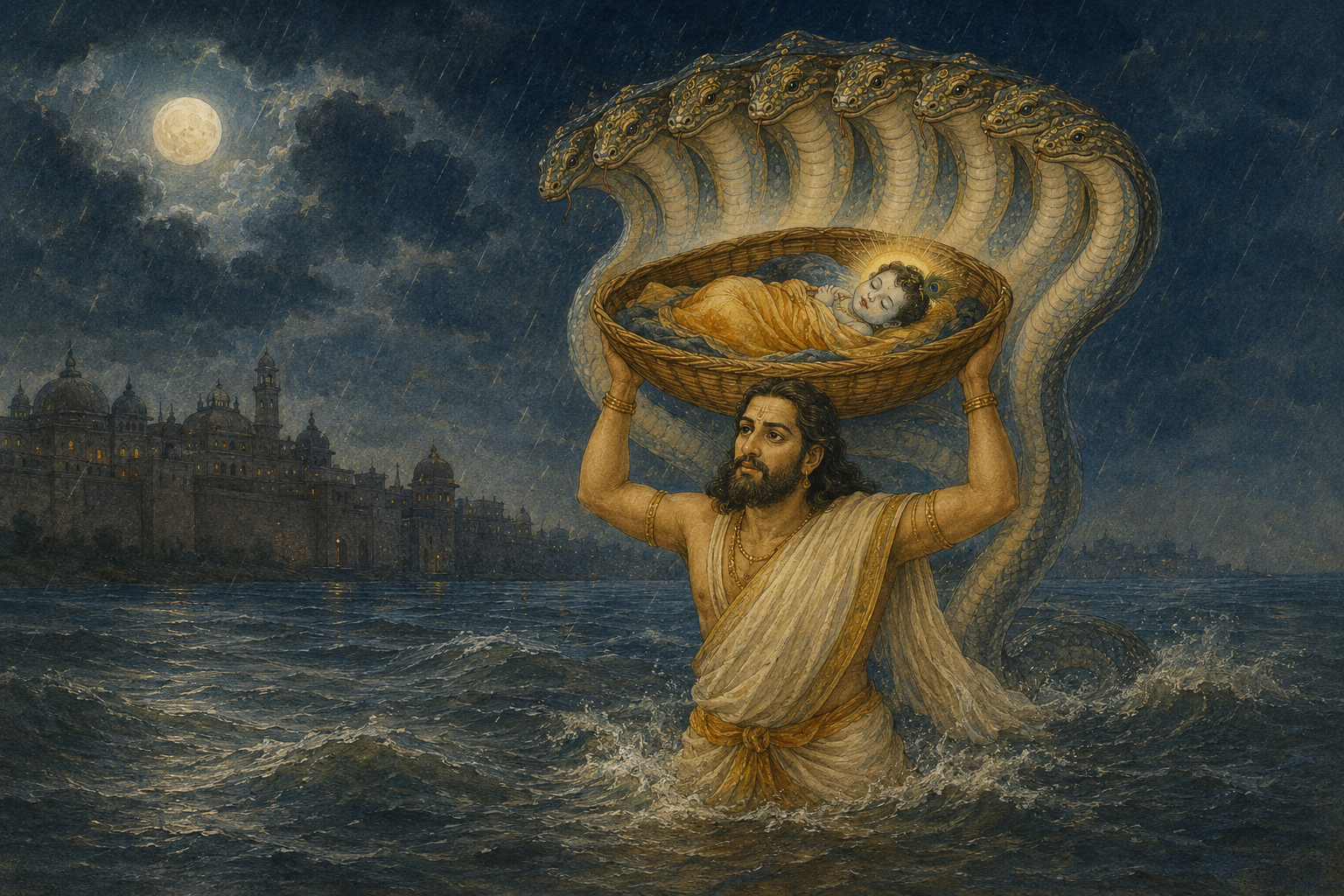
Krishna is born to Devaki and Vasudeva while they are held by Devaki’s brother, King Kamsa. Fearing a prophecy that Devaki’s child would end his rule, Kamsa has already killed her earlier children. On the night of Krishna’s birth, the prison doors open and Vasudeva carries the infant across the rain-swollen Yamuna to the pastoral settlement of Gokula. There Krishna is placed in the care of Nanda and Yashoda.
WHY IT MATTERS
The Divine enters a world of danger not through royal power, but through vulnerability, trust and protection.
PRIMARY TEXTSBhagavata Purana, Book 10; Vishnu Purana, Book 5; Harivamsha
Original Gokulas illustration · Inspired by Indian miniature and devotional painting traditions
02
ChildhoodGokula
The wonder of Bala Krishna
In Yashoda’s household, Krishna grows as a playful child—stealing butter, delighting the cowherd community and repeatedly escaping dangers sent by Kamsa. Stories such as the defeat of Putana, the overturning of the cart and Yashoda’s vision of the universe in Krishna’s mouth reveal the mystery at the heart of his childhood: the limitless Divine allows himself to be bound by a mother’s love.
WHY IT MATTERS
Bhakti makes the infinite intimate. Yashoda does not approach Krishna through fear, but through parental affection.
As Krishna grows, he tends calves and cows with Balarama and the cowherd boys. The forests, the Yamuna and Govardhan become the landscape of his play. Narratives of Kaliya, the forest fires and other dangers show Krishna protecting Vraja, while the sound of his flute becomes a lasting symbol of the soul being called toward divine love.
WHY IT MATTERS
Krishna’s divinity is revealed through friendship, beauty, play and care for the natural world.
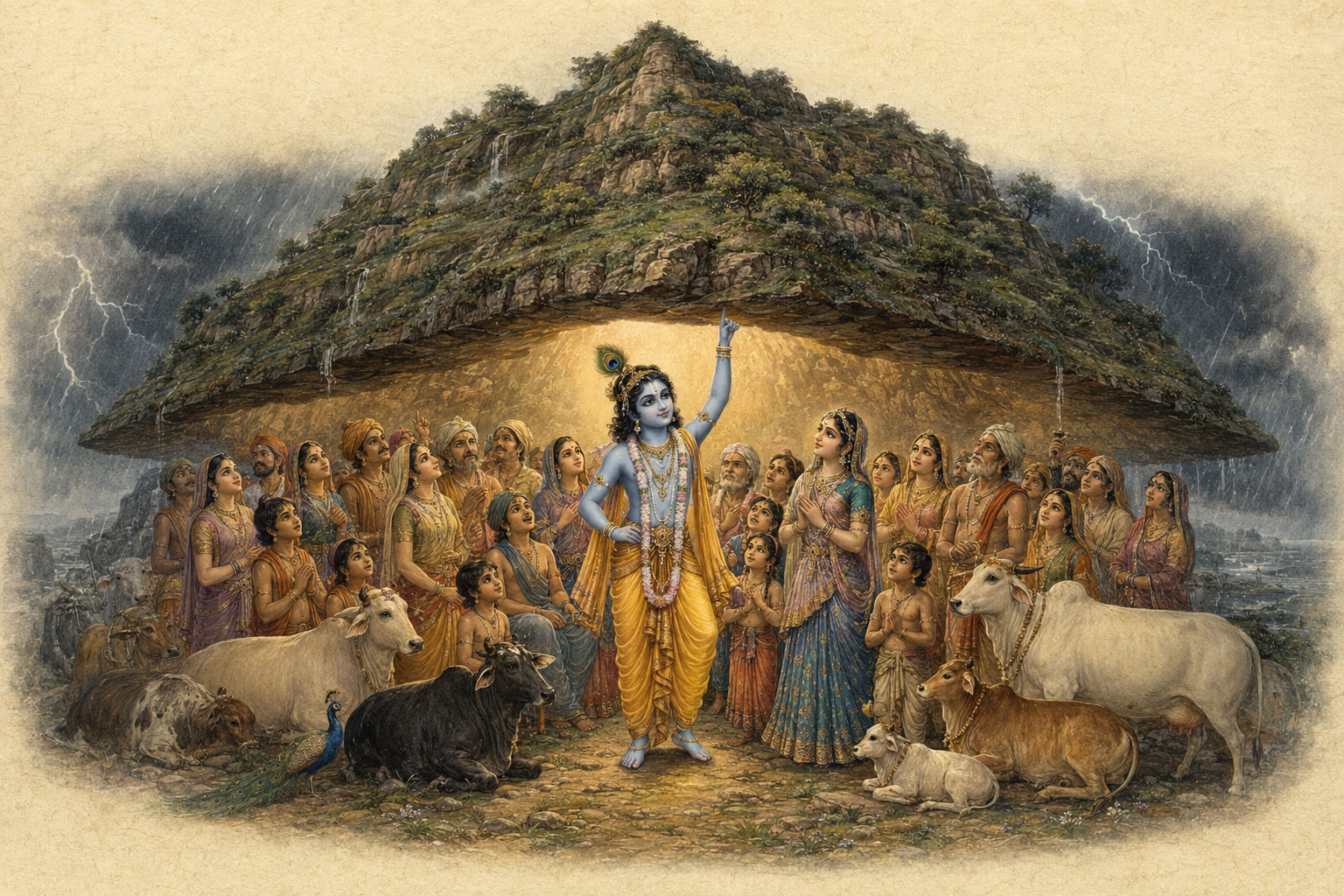
Krishna encourages the people of Vraja to honor Govardhan Hill, the cows and their own sustaining work. When Indra sends a devastating storm, Krishna lifts Govardhan and shelters the community beneath it for seven days. Indra’s pride is humbled, and Krishna is celebrated as Govinda.
WHY IT MATTERS
Spiritual life includes gratitude, humility and protection of the community and the living world that sustains it.
Original Gokulas illustration · Inspired by Indian miniature and devotional painting traditions
05
Radha & the gopisVrindavan
The devotion that asks for nothing
The rasa traditions remember Krishna’s moonlit dance with the gopis as a revelation of complete devotion. Radha, named and developed most fully in later devotional literature and living traditions, becomes the supreme expression of selfless love for Krishna. These narratives are understood theologically: the many souls turn wholly toward the one Divine beloved.
WHY IT MATTERS
The highest bhakti is love offered without bargaining, possession or demand for reward.
PRIMARY TEXTSBhagavata Purana 10.29–33; Gita Govinda; later Vaishnava traditions
06
ReturnMathura
The end of Kamsa’s rule
Summoned to Mathura, Krishna and Balarama leave Vraja. Krishna defeats Kamsa, releases Devaki and Vasudeva, and restores Kamsa’s father Ugrasena to the throne. The return is both a liberation and a separation: Krishna’s public responsibilities expand, while the people of Vraja continue to remember him in longing.
WHY IT MATTERS
Love and duty do not always keep us in the same place; remembrance bridges separation.
Facing repeated threats to Mathura, Krishna leads the Yadava community west and establishes Dwarka, the fortified city by the sea. The scriptures describe his marriages, family life, diplomacy and the protection of allies. Here the playful cowherd of Vraja is also seen as a ruler navigating the complexity of society.
WHY IT MATTERS
Spiritual wisdom is not confined to retreat; it can guide family, leadership, diplomacy and public responsibility.
Krishna becomes the close friend and kinsman of the Pandavas, especially Arjuna. As conflict with the Kauravas deepens, he offers counsel and undertakes a final peace mission. When war becomes unavoidable, Krishna refuses to bear arms and gives Arjuna a choice: his vast army, or Krishna himself as an unarmed ally. Arjuna chooses Krishna.
WHY IT MATTERS
True discernment recognizes that wise presence may be more valuable than material power.
PRIMARY TEXTSMahabharata, especially Udyoga Parva
09
The Bhagavad GitaKurukshetra
A teaching in the moment of crisis
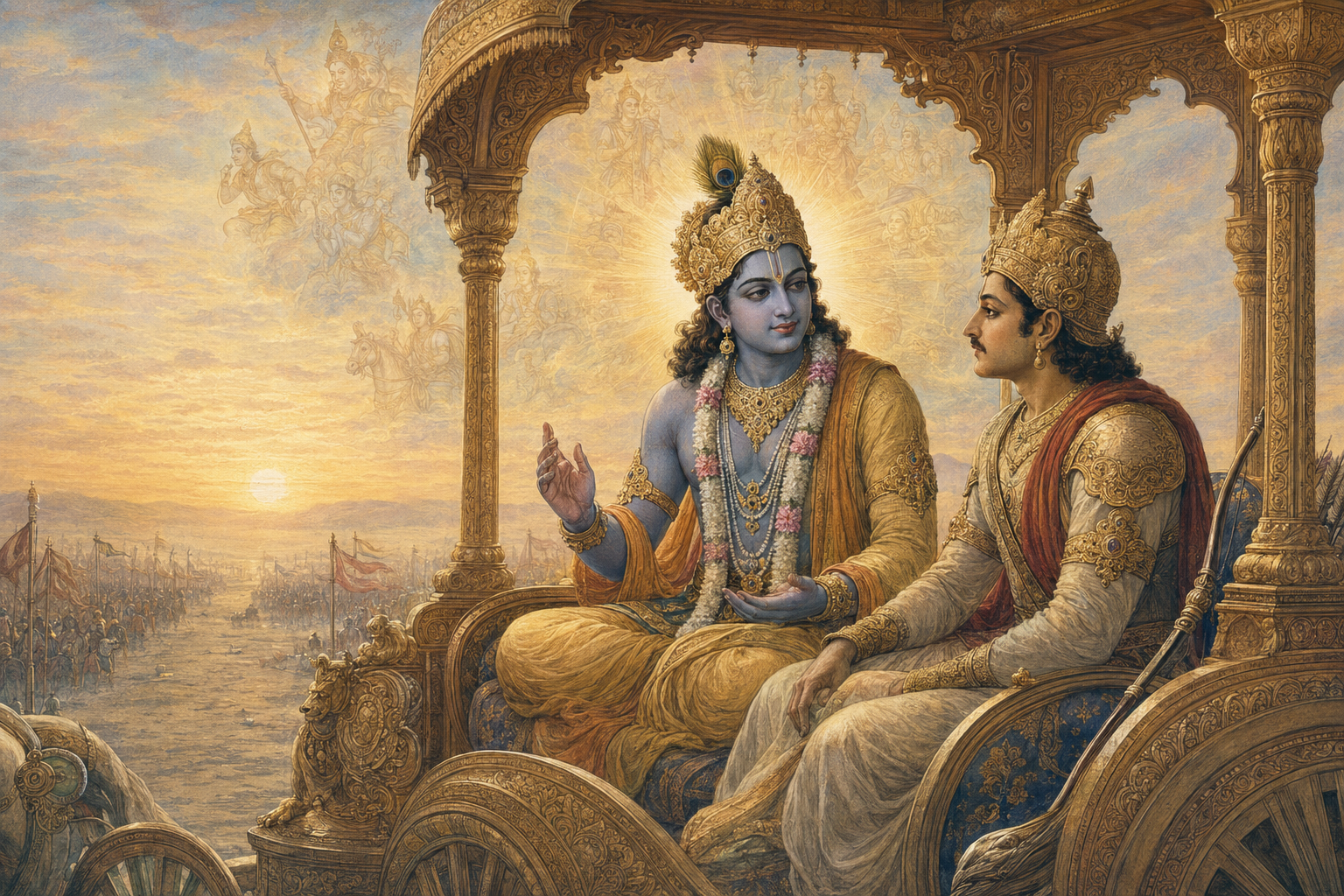
Seeing teachers, relatives and friends on both sides, Arjuna is overcome and refuses to fight. Krishna responds with the Bhagavad Gita: a far-reaching dialogue on the self, action, knowledge, meditation, devotion and surrender. He calls Arjuna neither to numbness nor blind obedience, but to clear understanding and disciplined action without selfish attachment.
WHY IT MATTERS
The Gita begins with an honest moral crisis. Its teaching asks how one may act faithfully when every choice carries consequence.
PRIMARY TEXTSMahabharata, Bhishma Parva 23–40; Bhagavad Gita
Original Gokulas illustration · Inspired by Indian miniature and devotional painting traditions
10
Departure & legacyPrabhasa
The visible story closes
After the war and the passing of years, the Yadava community is destroyed through an internal catastrophe. Krishna withdraws from earthly life at Prabhasa, and Dwarka is said to return to the sea. Devotional traditions do not treat this as the end of Krishna: his presence continues through sacred story, divine name, worship, pilgrimage and the practice of bhakti.
WHY IT MATTERS
Sacred presence outlives a single historical scene; remembrance turns narrative into living tradition.
PRIMARY TEXTSMahabharata, Mausala Parva; Bhagavata Purana, Book 11
A NOTE ON SOURCES
One story, many tellings.
Krishna’s life is preserved through a family of texts and centuries of regional devotion. The Mahabharata emphasizes his role as statesman, friend and guide; the Harivamsha and Puranas greatly expand his birth and early life; later poetry and lineage traditions deepen the theology of Radha and bhakti. Gokulas treats these as connected voices while naming the sources behind each account.